
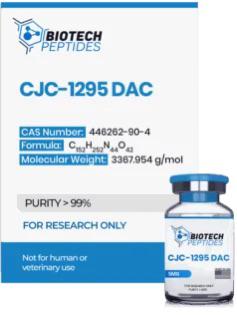
CJC-1295 DAC Peptide (10 vials) Original price was: $220.00.$210.00Current price is: $210.00.
Description
CJC-1295 DAC Peptide (10 vials)
CJC-1295 DAC peptide (10 vials) represents a pinnacle achievement in the field of growth hormone secretagogues (GHS). It is a synthetic analogue of Growth Hormone-Releasing Hormone (GHRH), specifically engineered to overcome the limitations of natural GHRH, which has an extremely short half-life. The inclusion of Drug Affinity Complex (DAC) technology fundamentally alters the pharmacokinetics of the peptide, transforming it into a long-acting agent. For research laboratories, endocrinologists, and anti-aging specialists studying the effects of sustained growth hormone (GH) elevation, the availability of CJC-1295 DAC in a 10-vial supply offers a robust platform for conducting high-impact, long-duration studies.
Mechanism of Action: The DAC Technology
The critical distinction of CJC-1295 lies in its chemical modification via the Drug Affinity Complex. Without DAC, peptides are rapidly cleared from the bloodstream by enzymes, often within minutes. The DAC component allows CJC-1295 to bind spontaneously and reversibly to circulating albumin, the most abundant protein in blood plasma.
By binding to albumin, the peptide creates a protective reservoir that shields it from enzymatic degradation and renal clearance. This mechanism extends the half-life of CJC-1295 DAC to approximately 6 to 8 days. Once bound, the peptide slowly dissociates from the albumin, allowing it to interact with the pituitary gland’s GHRH receptors over an extended period. This results in a sustained stimulation of somatotrophs, leading to a continuous, pulsatile release of endogenous growth hormone and a subsequent rise in Insulin-like Growth Factor 1 (IGF-1) levels.
Research Applications and Potential
The ability to maintain elevated GH and IGF-1 levels without the need for frequent daily injections makes CJC-1295 DAC a highly valuable tool in various research domains.
- Anabolic Research and Muscle Hypertrophy: The primary application of CJC-1295 DAC is in the study of muscle growth and tissue repair. By sustaining anabolic signaling, researchers investigate how increased IGF-1 levels influence protein synthesis, nitrogen retention, and the growth of lean muscle mass. It is often used in studies aiming to understand muscle wasting conditions and potential interventions.
- Lipolysis and Metabolic Health: Growth hormone is a potent regulator of metabolism. Research with CJC-1295 DAC focuses on its ability to promote lipolysis—the breakdown of adipose tissue. Studies examine how chronic GH elevation affects insulin sensitivity, glucose metabolism, and the reduction of visceral fat, offering insights into treating obesity and metabolic syndrome.
- Connective Tissue and Bone Density: Beyond muscle, GH and IGF-1 are critical for the health of connective tissues. Researchers utilize CJC-1295 DAC to study the regeneration of collagen, tendons, and cartilage, as well as its potential role in increasing bone mineral density in models of osteoporosis.
The 10-Vial Configuration: Stability for Longitudinal Studies
The packaging of CJC-1295 DAC in a 10-vial configuration is tailored for research protocols that span several weeks or months. Because the peptide has a long active life in the body, studies involving CJC-1295 DAC are typically long-term to observe the cumulative effects of sustained IGF-1 elevation.
Lyophilized peptides are sensitive to environmental factors such as moisture and heat. The 10-vial format mitigates the risk of degradation caused by repeated “freeze-thaw” cycles. Researchers can store the majority of the supply at a stable -20°C, removing only a single vial for reconstitution and immediate use. This ensures that the peptide used in the final week of a study is chemically identical to the peptide used in the first week, thereby preserving the validity and reproducibility of the experimental data.
Reconstitution and Handling
CJC-1295 DAC arrives in a vial containing lyophilized (freeze-dried) powder. To prepare the peptide for in vitro or in vivo research, it must be reconstituted with a suitable bacteriostatic solvent, such as bacteriostatic water or sodium chloride solution. The solution should be injected gently down the side of the vial, and the vial should be swirled gently to dissolve the powder; vigorous shaking should be avoided to prevent foaming and denaturation. Once reconstituted, the solution should be kept refrigerated and handled with strict aseptic technique to prevent contamination.
Safety and Regulatory Disclaimer
It is imperative to emphasize that CJC-1295 DAC is strictly intended for research purposes and laboratory testing only. It is not intended for human consumption, diagnosis, or treatment. While the peptide stimulates the body’s natural hormonal pathways, exogenous administration can lead to side effects such as water retention, tingling in the extremities, and potential insulin resistance. Furthermore, the “bleed” effect (constant GH release rather than pulses) is a specific area of study to understand potential receptor desensitization. All handling must be conducted by qualified professionals in a controlled laboratory environment, wearing appropriate Personal Protective Equipment (PPE) and adhering to all relevant safety guidelines.
Conclusion
CJC-1295 DAC stands as the “gold standard” for researchers looking to study the effects of sustained growth hormone elevation. Its innovative DAC technology solves the problem of short half-lives, allowing for consistent and controlled hormonal stimulation. The 10-vial supply kit provides the necessary logistical framework for rigorous scientific inquiry, ensuring that researchers can fully explore the anabolic, metabolic, and regenerative potential of this powerful peptide.


)
Reviews
There are no reviews yet.