
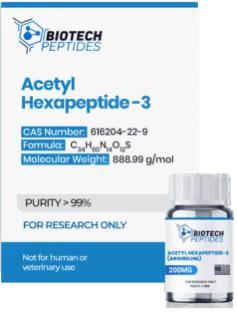
Acetyl Hexapeptide-3 (10 vials)
Acetyl Hexapeptide-3 (10 Vials): The Premier Peptide for Anti-Aging and Cosmetic Research
Acetyl Hexapeptide-3 (10 vials), widely recognized in the cosmetic and dermatological research communities under the trade name Argireline, stands as one of the most studied peptides in the field of anti-aging. As a synthetic peptide composed of six amino acids, it has garnered significant attention for its ability to mimic the effects of Botulinum Toxin (Botox) without the risks associated with injections or neurotoxins. For laboratories, research institutions, and cosmetic formulators, acquiring Acetyl Hexapeptide-3 in a 10-vial supply provides an optimal balance of stability, experimental volume, and cost-efficiency for rigorous testing.
Mechanism of Action: The “Botox-Mimetic” Effect
The primary appeal of Acetyl Hexapeptide-3 lies in its unique mechanism of action, which targets the formation of expression lines. At the molecular level, the peptide functions as a neurotransmitter inhibitor. When we make facial expressions—such as frowning, squinting, or smiling—nerve cells release neurotransmitters that signal the facial muscles to contract. Repeated contractions over time lead to the folding of the skin, resulting in dynamic wrinkles.
Acetyl Hexapeptide-3 (10 vials)
Acetyl Hexapeptide-3 interferes with this process by competing with the SNAP-25 protein, a crucial component of the SNARE complex. The SNARE complex is essential for the exocytosis of neurotransmitters (specifically catecholamines) into the synaptic cleft. By modulating the formation of this complex, Acetyl Hexapeptide-3 effectively inhibits the release of these neurotransmitters. Consequently, the muscle receives a weaker signal to contract, leading to a temporary relaxation of the facial musculature. This reduction in muscle tension allows the overlying skin to smooth out, diminishing the appearance of existing fine lines and preventing the deepening of new ones.
Research Applications and Benefits
In the realm of cosmetic science, Acetyl Hexapeptide-3 is a cornerstone ingredient for research into non-invasive anti-aging therapies. Unlike invasive procedures, this peptide offers a topical approach to skin rejuvenation, making it a subject of intense study for safety and efficacy profiles.
Research indicates that regular application of formulations containing Acetyl Hexapeptide-3 can lead to a visible reduction in wrinkle depth, particularly around the eyes (crow’s feet) and the forehead (glabellar lines). Beyond its muscle-relaxing properties, studies suggest that this peptide may also stimulate collagen and elastin production. By promoting extracellular matrix synthesis, it helps improve skin elasticity and hydration, addressing the structural causes of aging rather than just the symptomatic muscle contractions.
The 10-Vial Configuration: Ensuring Stability and Integrity
The packaging of Acetyl Hexapeptide-3 in a 10-vial set is designed to meet the stringent demands of scientific research and high-quality formulation. Peptides are inherently sensitive biomolecules that can degrade when exposed to moisture, heat, or repeated temperature fluctuations. A bulk supply divided into individual vials mitigates these risks through a strategy of compartmentalization.
Researchers can store the majority of the supply at recommended freezing temperatures (typically -20°C), removing only a single vial for reconstitution and immediate use. This prevents the degradation of the entire stock caused by the freeze-thaw cycles that occur when a single large container is opened and closed repeatedly. For clinical trials or formulation development, this ensures that the active ingredient used in week one of a study is chemically identical to the ingredient used in week ten, thereby preserving the integrity of the data.
Reconstitution and Handling
Acetyl Hexapeptide-3 typically arrives in a lyophilized (freeze-dried) powder form to maximize shelf life. For research purposes, it must be reconstituted with a suitable solvent, such as sterile water or a buffer solution, depending on the specific requirements of the formulation being tested. Once in solution, the peptide is generally stable for a limited period, necessitating prompt use or storage at refrigerated temperatures. Laboratories handling this peptide must adhere to aseptic techniques to prevent bacterial contamination, which could compromise experimental results.
Safety and Regulatory Considerations
While Acetyl Hexapeptide-3 is a common ingredient in consumer cosmetics, the raw peptide supplied in vials is strictly intended for research, formulation development, and laboratory testing. It is not intended for direct injection or human consumption in its raw form. Researchers should note that while the peptide is considered to have a favorable safety profile compared to neurotoxins, standard safety protocols— including the use of Personal Protective Equipment (PPE) like gloves and lab coats—must always be observed.
Conclusion
Acetyl Hexapeptide-3 remains at the forefront of peptide-based anti-aging research. Its ability to reduce muscle tension via neurotransmitter inhibition offers a scientifically validated, non-toxic alternative to traditional cosmetic procedures. The 10-vial supply format provides researchers and formulators with the practicality needed for long-term studies, ensuring that this potent peptide maintains its efficacy from the first experiment to the last. As the demand for non-invasive aesthetic solutions grows, Acetyl Hexapeptide-3 continues to be a vital tool in the science of skincare.
Reviews
There are no reviews yet.
Related products
Peptide
Peptide
Peptide
Peptide
Peptide
Peptide
Be the first to review “Acetyl Hexapeptide-3 (10 vials)”