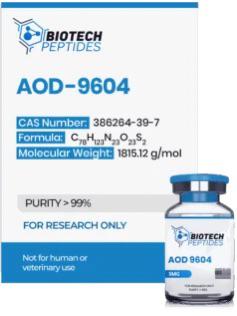
AOD-9604 Peptide (10 vials)
AOD-9604 peptide (10 vials), (Advanced Obesity Drug-9604) represents a significant breakthrough in the field of peptide research, specifically targeting the mechanisms of obesity and metabolic regulation. As a modified fragment of the human Growth Hormone (HGH)—specifically the C-terminus, encompassing amino acids 176-191—this peptide has been engineered to retain the fat-burning properties of the full hormone while discarding the effects associated with cell growth and insulin resistance. For research institutions and laboratories focused on lipolysis, weight management, and cartilage repair, a 10-vial supply of AOD-9604 provides an essential resource for conducting controlled, long-term studies.
Mechanism of Action: Selective Lipolysis
The primary interest in AOD-9604 lies in its unique ability to mimic the way natural Growth Hormone regulates fat metabolism without the adverse side effects often seen with HGH therapy. The peptide works by stimulating the process of lipolysis, which is the breakdown of stored fat (triglycerides) into free fatty acids, which the body can then use for energy.
Specifically, AOD-9604 interacts with beta-3 adrenergic receptors on the surface of adipose (fat) cells. This interaction triggers a signal transduction pathway that activates hormone-sensitive lipase, the enzyme responsible for mobilizing fat stores. Crucially, research suggests that AOD-9604 also inhibits lipogenesis—the transformation of non-fat foods into body fat. This dual action of burning existing fat while blocking the creation of new fat makes it a highly potent subject for metabolic research. Furthermore, the peptide includes a tyrosine residue added to the C-terminus, which enhances its stability and extends its half-life in the body compared to the natural fragment.
Research Applications and Potential
While originally developed for the treatment of obesity, the scope of AOD-9604 research has expanded significantly over the years.
- Obesity and Weight Management: This remains the primary domain of study. In preclinical and clinical trials, AOD-9604 has shown promise in reducing body weight and specifically targeting stubborn visceral fat. Unlike generic weight loss stimulants, it appears to have a high affinity for abnormal fat deposits, making it a critical tool for studying metabolic syndrome.
- Cartilage Repair and Osteoarthritis: Surprisingly, research has uncovered that AOD-9604 exhibits anabolic properties in cartilage and bone. Studies indicate that it can stimulate the proliferation of chondrocytes (cartilage cells) and osteoblasts (bone cells). This has opened a new avenue of research into its potential for treating osteoarthritis and repairing joint damage, distinguishing it from pure weight-loss compounds.
The 10-Vial Configuration: Ensuring Stability and Dosage Precision
The packaging of AOD-9604 in a 10-vial configuration is designed to meet the rigorous standards of scientific experimentation. Peptides, by their nature, are sensitive to environmental degradation. Once reconstituted with a solvent, a peptide solution has a limited shelf life. If a researcher were to purchase a single large vial, the process of repeatedly withdrawing doses and returning the vial to storage would introduce contaminants and degrade the peptide’s potency through repeated temperature fluctuations.
The 10-vial format solves this problem by allowing for compartmentalization. Researchers can store the majority of the supply in a freezer at -20°C to preserve the lyophilized (freeze-dried) powder’s integrity. A single vial can be reconstituted for immediate use in a specific study phase, while the others remain pristine. This is particularly beneficial for studies that require daily dosing over several weeks, ensuring that the compound used on day 30 is chemically identical to the compound used on day 1.
Reconstitution and Handling
AOD-9604 typically arrives in a vial containing 2mg or 5mg of lyophilized powder. To prepare the peptide for research administration, it must be reconstituted with bacteriostatic water or sterile water for injection. The solvent is injected slowly into the vial to avoid degrading the peptide foam, and the vial is then gently swirled until the powder is fully dissolved. The resulting solution is clear and ready for subcutaneous injection in animal models or for application in cell cultures. Strict aseptic techniques must be followed during this process to ensure the validity of the experimental results.
Safety and Regulatory Disclaimer
It is imperative to note that AOD-9604 is strictly intended for research purposes and laboratory testing only. Although it has undergone clinical trials in the past, it is not currently approved by the FDA as a medication for human weight loss or arthritis. Therefore, it is not intended for human consumption or diagnostic use. Researchers handling this peptide should be aware that while the side effect profile is generally favorable compared to full HGH, potential reactions can still occur. All handling must be performed by qualified professionals wearing appropriate Personal Protective Equipment (PPE) in a controlled laboratory environment.
Conclusion
AOD-9604 stands at the forefront of peptide-based metabolic research, offering a targeted approach to fat loss and tissue regeneration that distinguishes it from its parent hormone, HGH. The 10-vial supply format provides the logistical stability and dosing precision required for high-caliber scientific inquiry. As the global scientific community continues to seek effective treatments for obesity and degenerative joint diseases, AOD-9604 remains a vital and promising compound in the ongoing quest to understand and improve human metabolic health.
Reviews
There are no reviews yet.
Related products
Peptide
Peptide
Peptide
Peptide
Peptide
Peptide
Peptide
Be the first to review “AOD-9604 Peptide (10 vials)”