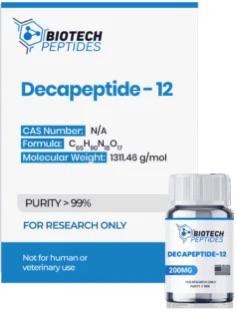
Decapeptide-12 (10 vials)
Decapeptide-12 (10 vials) is a synthetic oligopeptide that has rapidly become a subject of intense interest in the fields of dermatology, cosmeceutical science, and pigmentary disorders. Marketed under the trade name Lumixyl, this peptide is specifically engineered to address hyperpigmentation by targeting the biological pathways responsible for skin color. For research institutions and laboratories focused on melanogenesis, skin biology, and the development of novel depigmenting agents, the availability of Decapeptide-12 in a 10-vial supply provides a highly controlled and stable medium for conducting advanced studies.
Mechanism of Action: Targeting Tyrosinase
The primary mechanism of action of Decapeptide-12 centers on its ability to inhibit the activity of the tyrosinase enzyme. Tyrosinase is the rate-limiting enzyme in the production of melanin, the pigment responsible for the color of skin, hair, and eyes. In conditions like melasma, age spots, and post-inflammatory hyperpigmentation, tyrosinase activity is often upregulated, leading to excessive melanin deposition.
Decapeptide-12 functions as a competitive inhibitor. Structurally, it mimics the substrate (tyrosine) that tyrosinase would normally bind to in order to start the melanin synthesis cascade. However, instead of being processed into pigment, Decapeptide-12 binds to the active site of the enzyme and blocks it. This prevents the natural substrate from attaching, effectively halting the conversion of tyrosine into melanin. Crucially, research indicates that Decapeptide-12 achieves this inhibition without causing cytotoxicity to the melanocytes (pigment-producing cells), distinguishing it from harsher traditional agents like hydroquinone, which can damage or kill cells.
Research Applications and Potential
Decapeptide-12 is primarily investigated for its efficacy in treating various forms of hyperpigmentation, offering a potentially safer alternative to existing therapies.
- Treatment of Melasma: One of the most significant areas of research involves melasma, a chronic skin condition characterized by brown or gray-brown patches, often triggered by sun exposure or hormonal changes. Studies focus on Decapeptide-12’s ability to reduce the intensity of these patches by normalizing melanin production over time.
- Skin Brightening and Tone: Beyond pathological hyperpigmentation, the peptide is studied for general cosmetic benefits. Research explores its potential to improve overall skin luminosity and even out skin tone by modulating baseline melanin levels.
- Comparison Studies: Laboratories utilize Decapeptide-12 in comparative studies against other tyrosinase inhibitors, such as kojic acid, arbutin, and hydroquinone. These studies aim to quantify relative efficacy, speed of results, and safety profiles, particularly focusing on the lack of irritation often associated with other depigmenting agents.
- Synergistic Formulations: Research is also being conducted on how Decapeptide-12 interacts with other topical agents, such as antioxidants or chemical exfoliants, to determine if combination therapies can enhance melanin suppression or skin barrier repair.
The 10-Vial Configuration: Ensuring Purity and Potency
The packaging of Decapeptide-12 in a 10-vial configuration is designed to meet the stringent requirements of formulation chemistry and biological testing. Peptides are inherently sensitive to environmental stressors; oxidation and hydrolysis can degrade the peptide chains, rendering them ineffective.
A 10-vial supply allows researchers to adopt a conservative storage strategy. The majority of the stock can be kept in a freezer at -20°C in a lyophilized (freeze-dried) state, where the peptide is most stable. Individual vials are removed only as needed for specific formulation batches or experimental runs. This prevents the degradation of the entire inventory through “freeze-thaw” cycles or repeated exposure to room temperature air. For studies that require consistent dosing over several weeks to mimic a course of treatment, this format ensures that the material used in the final week is just as potent as that used in the first.
Reconstitution and Handling
Decapeptide-12 typically arrives as a white, lyophilized powder. To prepare the peptide for research, it must be reconstituted with a suitable solvent. Depending on the specific protocol—whether for in vitro cell culture studies or for the creation of a topical vehicle—it is commonly dissolved in sterile water, bacteriostatic water, or a specific buffer solution. Once reconstituted, the solution is generally clear. Researchers must employ aseptic techniques to prevent contamination. It is important to note that for topical research, the peptide is often further diluted into creams, serums, or gels to test its transdermal absorption and efficacy.
Safety and Regulatory Disclaimer
It is imperative to emphasize that Decapeptide-12 is strictly intended for research purposes and laboratory testing only. It is not intended for human consumption, topical application, or use as a cosmetic product outside of a controlled research environment. While Decapeptide-12 is generally considered to have a favorable safety profile compared to hydroquinone, it is an experimental substance. All handling must be conducted by qualified professionals in a controlled laboratory environment, wearing appropriate Personal Protective Equipment (PPE) and adhering to all relevant safety guidelines.
Conclusion
Decapeptide-12 represents a sophisticated, targeted approach to the management of skin pigmentation. By specifically inhibiting the tyrosinase enzyme without damaging cells, it offers a promising avenue for the development of next-generation treatments for melasma and photoaging. The 10-vial supply provides the stability and resource flexibility necessary for researchers to fully explore the capabilities of this peptide, potentially leading to safer and more effective solutions for achieving a balanced, even skin tone.


Be the first to review “Decapeptide-12 (10 vials)”