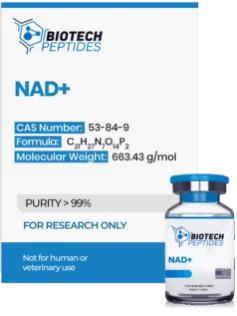
NAD+ PEPTIDE (10 VIALS)
NAD+ peptide (10 vials), Nicotinamide Adenine Dinucleotide (NAD+) is one of the most critical and abundant coenzymes found in every living cell. Often described in the scientific community as the “molecule of youth” due to its precipitous decline with age, NAD+ plays a fundamental role in energy metabolism and cellular repair. For researchers exploring the frontiers of aging, neuroprotection, and metabolic health, obtaining NAD+ in a 10-vial supply provides a rigorous framework for studying how this essential molecule influences vitality and lifespan at a cellular level.
Mechanism of Action: Powering the Cell
The biological necessity of NAD+ cannot be overstated. It functions primarily as an electron carrier, facilitating the transfer of electrons in the mitochondria to drive oxidative phosphorylation—the process by which cells convert nutrients into adenosine triphosphate (ATP), or energy. Without adequate levels of NAD+, the mitochondria cannot function efficiently, leading to cellular fatigue and degeneration.
However, recent research highlights that NAD+ is also a vital substrate for several families of proteins, most notably the sirtuins (SIRT genes) and PARPs (Poly ADP-ribose polymerases). Sirtuins are often referred to as “longevity genes” because they repair damaged DNA, regulate inflammation, and resist oxidative stress. NAD+ is the fuel required for sirtuins to function; therefore, declining NAD+ levels directly inhibit the body’s natural ability to repair itself. By administering exogenous NAD+, researchers aim to restore these levels, thereby reactivating the cellular defense mechanisms that keep tissues healthy and resilient.
Research Applications and Potential
The scope of NAD+ research is vast and spans multiple medical disciplines.
- Anti-Aging and Longevity: The primary focus is on mitigating the effects of senescence (cellular aging). Studies investigate whether restoring NAD+ levels can reverse biomarkers of aging in tissues, improve muscle function, and enhance physical endurance.
- Neuroprotection: The brain consumes massive amounts of energy and is highly susceptible to mitochondrial dysfunction. Research is currently examining NAD+’s potential to protect neurons from degeneration, offering promising avenues for studying conditions like Alzheimer’s, Parkinson’s, and age-related cognitive decline.
- Metabolic Health: NAD+ is crucial for insulin sensitivity and glucose metabolism. Laboratories are using this peptide to research potential interventions for Type 2 diabetes and obesity, looking at how improved mitochondrial function can regulate metabolic syndromes.
- Addiction and Recovery: Emerging research suggests that NAD+ may help repair brain cells damaged by substance abuse and reduce withdrawal symptoms, making it a subject of interest in addiction medicine studies.
The 10-Vial Configuration: Ensuring Stability and Efficacy
In the context of laboratory research, the integrity of the molecule is paramount. NAD+ is a sensitive compound that can degrade when exposed to light, heat, or moisture. The 10-vial configuration is engineered to preserve the peptide’s bioactivity from the first experiment to the last.
By supplying NAD+ in multiple individual vials, researchers can avoid the degradation risks associated with “freeze-thaw” cycles. If a large container were used repeatedly, fluctuations in temperature would compromise the solution’s potency. With 10 vials, the majority of the supply can remain cryogenically frozen (typically at -20°C or lower) while only one vial is reconstituted and used for immediate experimentation. This format is ideal for longitudinal studies that require consistent dosing over several weeks or months, ensuring that the subjects or cell cultures are treated with a compound of unvarying potency.
Reconstitution and Handling
NAD+ typically arrives in a lyophilized (freeze-dried) powder form. To prepare it for research applications, it must be reconstituted with a bacteriostatic solvent, such as bacteriostatic water or sodium chloride solution. The reconstitution process transforms the powder into a clear solution ready for administration in animal models or cell cultures. Researchers must adhere to strict aseptic techniques to ensure the solution remains sterile. Once reconstituted, NAD+ should generally be stored in a refrigerator and used within a specific timeframe to prevent oxidation.
Safety and Regulatory Disclaimer
While NAD+ is an endogenous molecule naturally produced by the body, the synthetic peptide supplied in vials is strictly intended for research and laboratory use only. It is not intended for human consumption, diagnosis, or treatment. Researchers should be aware that while NAD+ supplementation is generally well-tolerated in clinical settings, high doses can sometimes cause mild side effects such as nausea, flushing, or fatigue. All handling must be conducted by qualified professionals in a controlled laboratory environment, adhering to all relevant safety guidelines.
Conclusion
NAD+ stands at the intersection of metabolism and aging, serving as a critical link between the energy we produce and the longevity we enjoy. The 10-vial supply of NAD+ peptide offers researchers the precision and stability required to unravel the complexities of this coenzyme. As the scientific community continues to search for interventions to extend healthspan and combat age-related diseases, NAD+ remains one of the most promising and extensively studied molecules in modern biotechnology.


Be the first to review “NAD+ PEPTIDE (10 VIALS)”